What is Comprehensive Eye Care? A Deep Dive into Total Vision Wellness
Most patients walk into an eye clinic thinking they are just there to “check their numbers” for a new pair of glasses. However, in the world of professional optometry and ophthalmology, a simple sight test is only a tiny fraction of what we call Comprehensive Eye Care.
A comprehensive eye exam is a holistic medical assessment of the organ of sight, its neurological pathways, and the vascular systems that support it. It is the difference between simply seeing the letters on a chart and ensuring those eyes will continue to see for the next fifty years.
In this guide, we break down what separates a “screening” from a “comprehensive exam” and exactly what happens during a professional assessment at a clinic like Perfect Vision.
1. Vision Screening vs. Comprehensive Eye Exam: The Critical Difference
It is common to see “free vision screenings” at schools, workplaces, or community centers. While these are valuable for catching gross vision errors, they are not medical exams.
- Vision Screening: A brief test (often 5 minutes) that only checks visual acuity (how clearly you see distance). It is a pass/fail test. It cannot diagnose glaucoma, retinal thinning, or diabetic changes.
- Comprehensive Eye Exam: A 30 to 60-minute medical evaluation performed by a Doctor of Optometry. It involves internal and external health checks, neurological assessments, and precision refraction. Research shows that 1 in 4 children who pass a vision screening still have an undiagnosed vision problem that affects their learning.
2. The 8 Critical Steps of a Comprehensive Eye Exam
When you visit a clinical facility, your journey through comprehensive care typically follows these eight research-backed steps:
I. Patient History and Lifestyle Assessment
The doctor begins by discussing your general health. Because the eye is connected to the rest of the body, conditions like diabetes, hypertension, and even certain medications (for malaria or arthritis) can have profound effects on the retina and cornea.
II. Visual Acuity (The Snellen Test)
This measures the “sharpness” of your vision. We test each eye individually to determine if you are hitting the “20/20” standard or if there is a refractive gap that needs closing.
III. Preliminary Neurological Tests
This involves checking your pupillary response (how your pupils react to light) and ocular motility (how well your eye muscles move together). Abnormalities here can be early indicators of neurological issues or brain tumors.
IV. Keratometry and Refraction
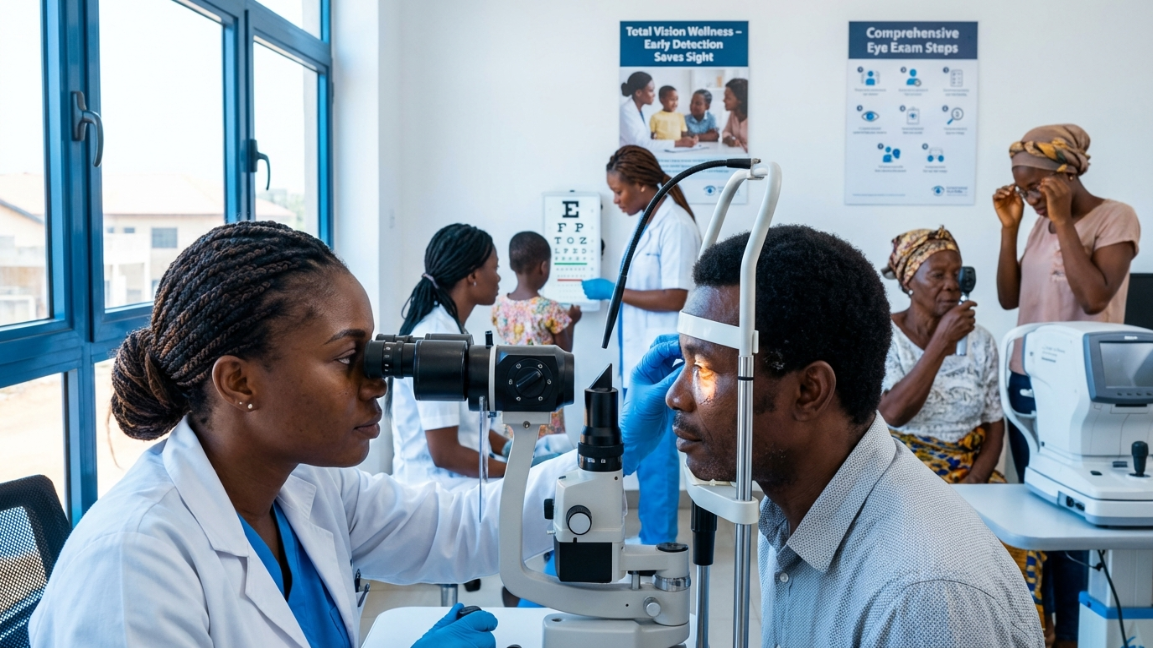
Using a phoropter (the large “binocular” machine), the doctor measures exactly how light bends as it enters your eye. This isn’t just about finding a prescription; it’s about determining if you have nearsightedness, farsightedness, or astigmatism.
V. Tonometry (Eye Pressure Test)
This is the gold standard for Glaucoma screening. A tonometer measures the internal pressure of the eye. High pressure can silently crush the optic nerve, leading to permanent tunnel vision and blindness.
VI. Slit-Lamp Examination (Biomicroscopy)
Using a high-powered microscope with a “slit” of light, the doctor examines the front of the eye. This allows for the detection of early cataracts, corneal scratches, and dry eye syndrome.
VII. Dilation and Retinal Assessment (Funduscopy)
To truly see the “engine” of the eye, the doctor may use drops to dilate your pupils. This provides a wide-angle view of the Retina, Optic Nerve, and Macula. This is where we catch signs of diabetic retinopathy and macular degeneration.
VIII. Binocular Vision Assessment
The doctor checks how your eyes work as a team. Issues with depth perception or “eye teaming” can lead to severe headaches, double vision, and reduced reading speed in children.
3. Why “Comprehensive” Matters for Different Ages
For Children: Developmental Milestones
In pediatric care, the focus is on Amblyopia (lazy eye) and Strabismus (eye turn). If these aren’t caught during a comprehensive exam before age 8, the brain may permanently “shut off” vision in one eye, a condition that cannot be corrected with glasses later in life.
For Adults: Chronic Disease Management
For adults, comprehensive care is about monitoring the impact of the Ghanaian environment (UV exposure and dust) and systemic health. It is often the only way to detect the “Silent Thief of Sight”—Glaucoma—which has a high prevalence in the Ashanti region.
For Seniors: Preserving Independence
As we age, the risk of cataracts and Age-Related Macular Degeneration (AMD) increases. Comprehensive care ensures that seniors maintain the visual acuity needed for driving, reading, and maintaining their independence.
4. The Value of Clinical Standards (HeFRA)
In Ghana, a comprehensive eye exam should only be performed in a facility licensed by the Health Facilities Regulatory Agency (HeFRA). A licensed clinic ensures that:
- The equipment is calibrated and modern.
- The personnel are qualified (Doctors of Optometry or Ophthalmic Surgeons).
- The environment is sterile and professional.
Conclusion: Total Vision Wellness
Comprehensive Eye Care is more than a prescription; it is a vital part of your preventative healthcare routine. By looking inside the eye, we aren’t just checking your sight—we are checking your life.
At Perfect Vision Eye Care Clinic, our comprehensive exams are designed to be thorough, educational, and personalized. We use the latest diagnostic technology to ensure that every patient walks out with a clear understanding of their ocular health.
Is your vision truly healthy, or are you just “getting by”? Book your comprehensive eye exam today and experience the difference of total vision wellness.
About the Author: Perfect Vision Editorial focuses on clinical education and public health awareness. Our mission is to bridge the gap between basic screenings and professional medical eye care for the people of Kumasi and beyond.